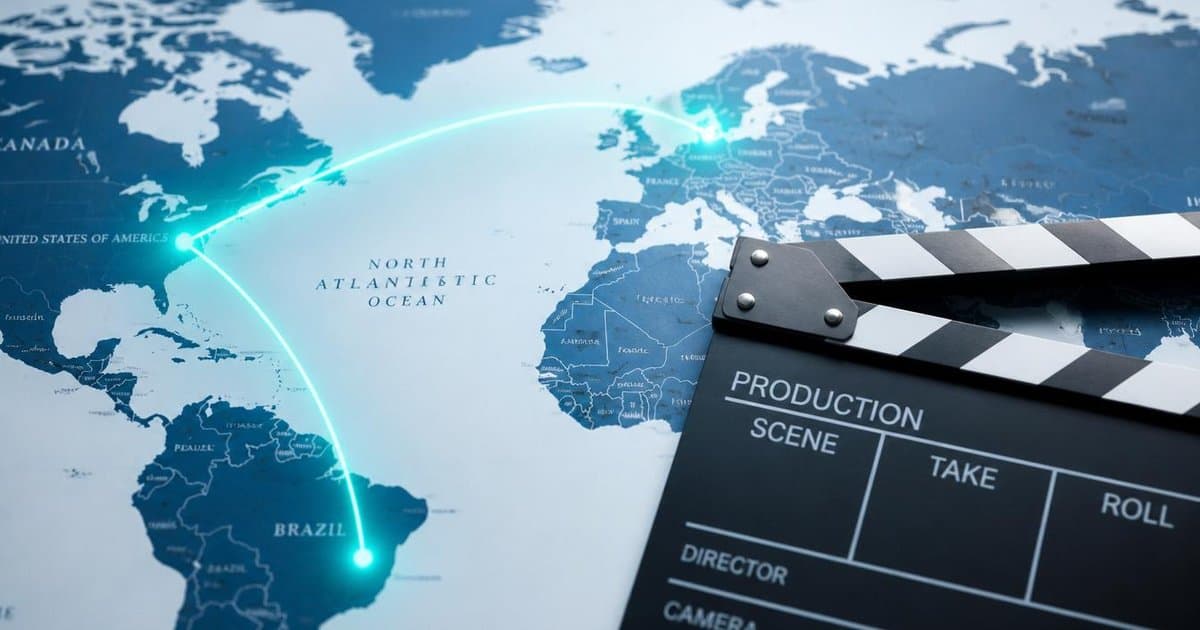
A co-production is a single film built by partners in different countries, and that is exactly what makes its ownership complicated. The money, the writers, the design, the footage, and the legal expectations all come from different jurisdictions, each with its own rules and its own paperwork. When a financier or distributor asks who owns what and when it was created, the answer has to satisfy more than one legal system at once. Proof that stops at a border is not proof a co-production can use. Here is what these deals actually require.
What proof do international film co-productions require?
At the core, the same thing every film deal requires, chain of title, the unbroken record of who created and held the rights at each step. The difference in a co-production is that this record has to hold up for partners and authorities in several countries, not one.
That means three things have to be evidenced cleanly: who contributed what, when each contribution was created, and that the materials have not been altered since. Co-production treaties and national filings handle parts of the formal rights picture. What they do not give you is a single, shared, trustworthy record of creation that every partner and financier can rely on. That gap is where cross-border deals get stuck.
Why does chain of title get harder across borders?
Domestically, chain of title is already where deals break, in development, before contracts catch up. Add borders and it compounds:
- Each country has its own formal IP system, and there is no single global registration that covers them all.
- Partners create and exchange materials in different places, with different record-keeping habits.
- Dates and provenance recorded in one partner's local files mean little to a financier in another country.
- A distributor or insurer in one territory may not trust documentation produced under another's conventions.
The result is a lot of effort spent reconciling provenance late, under deadline, when any unproven link can hold up financing or a distribution close. And because the partners sit in different time zones and legal systems, closing that gap late is slower than it would be in a single-country deal, every clarification crosses a border and waits on someone else's counsel before the close can move.
How do you prove ownership of a work in another country?
This is the practical question, and the honest starting point is that formal rights are largely territorial. There is no one registration that makes you the recognized owner everywhere. What you can do is hold proof of creation that is independent of any single country's system, and that more than one legal system already accepts.
China's Hangzhou Internet Court accepted a hash-anchored timestamp as evidence of authorship in 2018. The World Intellectual Property Organization recognized distributed-ledger timestamps as a valid tool for proof of existence in 2022. In 2025, the Marseille Court of Appeal in France accepted on-chain timestamps as valid evidence of a creation date. Under the EU eIDAS Regulation, Qualified Timestamps carry a legal presumption of date and integrity across all 27 member states.
The significance for a co-production is the spread: the same form of proof has been recognized across different jurisdictions. A record like that does not replace national rights, but it gives every partner and financier one creation-date record they can all verify, regardless of where they sit.
What is the advantage of a single global record over filing country by country?
Filing for formal rights in every relevant country is slow, expensive, and still does not produce one shared proof of when the work was created. A single, dated, unalterable record does.
An on-chain timestamp is created once and verifiable from anywhere. Instead of each partner trusting the others' local paperwork, they all point to the same record: this treatment, this draft, this footage existed on this date and is unchanged. It is the proof layer that travels, sitting underneath whatever national registrations and treaty filings the deal also requires. The same proof layer applies at the development stage, to a script or treatment before it is shared with partners.
How do co-producers document each partner's contribution?
The fairness of a co-production rests on who brought what, and that is easiest to settle if it was recorded as it happened. Each partner timestamps the materials they create, the treatment, the drafts, the design, the footage, as they create them.
The result is one shared, dated trail showing every contribution and when it entered the project, that no single partner can later rewrite. It does not set the split, but it removes the cross-border version of the "we developed that" argument, where memories and local records disagree and there is no neutral reference.
How do you make a co-production deal-ready across jurisdictions?
Work backward from what the financiers, distributors, and insurers in every territory will ask for: provable creation, documented contributions, reliable dates, all verifiable from where they stand. Build it as the project develops, across all partners, not at the close.
Start with the shared proof layer: an immutable, dated record for every material each partner creates, verifiable from any country. Then handle national registrations and treaty paperwork on top. A co-production built this way can answer "prove it" the same way for a partner in Paris, a financier in Toronto, and a distributor in Singapore. One built without it spends the close reconciling provenance across borders under deadline.
Where co-production proof tends to break
The gaps in a cross-border deal are predictable once you have seen a few. A partner shoots footage in their country and never timestamps it, so its provenance rests on their local files alone. A writer brought in from a third country delivers pages with no shared record of the date or the handoff. A financier's local counsel will not accept documentation produced under another jurisdiction's conventions, and asks for it to be redone. A treatment circulates among three partners by email, and a year later none of them can show who shaped which part.
Each of these is the same failure in a different costume: provenance recorded in one place, under one country's habits, that the other partners and their advisors do not fully trust. A single, neutral, dated record that every partner contributes to and can verify removes the costume and the failure with it. The point is not to add another layer of paperwork. It is to give a deal built across borders one source of proof that does not stop at any of them.
A co-production is one film and several legal systems. The treaty paperwork, the title report, the contracts, those are formats, and they are territorial. What lets a cross-border project hold together is permanent, unchangeable proof of what was created and when, that every partner and every market can verify from where they are.